
Simple Breathing Exercises for a Calmer Bedtime Wind-Down
Many people do everything "right" before bed-skincare routine, herbal tea, low lights-yet still find their minds racing once they lie down. One of the most effective, low-effort ways to bridge that gap between "tired" and "actually sleepy" is controlled breathing. Simple breathing exercises can shift the body from a wired, stress-responsive state into a calmer, more restful one, and they require no equipment, special space, or prior experience.
This guide focuses on accessible, science-informed breathing techniques that can be integrated into an evening ritual alongside skincare, relaxation, or other wellness practices. The aim is not perfection or strict rules, but a small set of tools that can make bedtime feel softer, slower, and more under your control.
Why Breathing Exercises Help Before Sleep
The way a person breathes directly affects the nervous system. Rapid, shallow breathing is often associated with the sympathetic nervous system, the "fight or flight" response that raises heart rate, blood pressure, and alertness. Slow, controlled breathing helps activate the parasympathetic nervous system, sometimes called "rest and digest," which promotes relaxation and recovery.
Research has shown that slow, paced breathing can reduce heart rate and blood pressure, and increase heart rate variability, a marker associated with better stress resilience. For example, studies on slow breathing at around six breaths per minute have found improvements in measures of relaxation and autonomic balance, including work published in journals like Frontiers in Human Neuroscience and Breathe from the European Respiratory Society. The American Heart Association has also noted that slow, deep breathing can help lower blood pressure in some individuals, particularly when combined with other lifestyle measures.
At night, this matters because insomnia and difficulty falling asleep are often linked to heightened arousal-mentally, emotionally, or physically. The American Academy of Sleep Medicine and organizations such as the National Sleep Foundation highlight relaxation techniques, including breathing exercises, as evidence-based components of cognitive behavioral therapy for insomnia. While breathing alone is not a cure for chronic sleep disorders, it can be a useful, low-risk tool in a broader bedtime routine that also includes consistent sleep times, a comfortable environment, and limited blue-light exposure.
For beauty and skincare enthusiasts, there is an extra motivation: quality sleep supports skin barrier recovery, collagen production, and reduced inflammation. Research summarized by dermatology organizations and resources like the American Academy of Dermatology highlights how chronic poor sleep can worsen conditions such as acne, eczema, and dullness. A short breathing practice before bed can therefore be seen not just as a mental health habit, but as part of an overall skincare and wellness strategy.
Setting the Scene: Preparing for Breathing Practice
Before starting any specific exercise, it helps to create a simple pre-sleep environment that encourages the body to wind down. This does not need to be elaborate or expensive. Dimming overhead lights at least 30-60 minutes before bed, avoiding stimulating screens where possible, and finishing stimulating tasks (email, work, intense workouts) earlier in the evening make it easier for breathing techniques to have a noticeable effect.
Positioning matters as well. Many people prefer to practice breathing while already in bed, lying on their back with a pillow that supports the neck without forcing the chin toward the chest. Others find it more comfortable to sit upright against the headboard with knees slightly bent. The key is a position that allows the diaphragm to move freely-tight waistbands, heavy blankets pressing on the abdomen, or curled-up postures can make deep breathing more difficult. If a person uses a nighttime beauty ritual-cleansing, treatments, and moisturizers-doing that first and then transitioning into breathing can create a consistent evening routine cue that signals "sleep time" to the brain.
It can help to turn breathing practice into a small ritual: perhaps a few drops of a favorite (skin-safe) body oil after a shower, soft background sounds like rain or white noise, or a gentle stretch sequence before climbing into bed. While aromatherapy with lavender or chamomile is popular, readers with asthma, allergies, or sensitive skin should be cautious with essential oils, as organizations like the American Lung Association and dermatology societies note that fragrance can trigger irritation or respiratory symptoms in some individuals.
Exercise 1: Diaphragmatic (Belly) Breathing
Diaphragmatic breathing, often called belly breathing, is one of the simplest and most foundational techniques. Instead of shallow breaths that mainly move the upper chest, this method encourages fuller breaths that engage the diaphragm, the large muscle beneath the lungs. Studies cited by institutions such as Harvard Medical School and Cleveland Clinic suggest diaphragmatic breathing can reduce stress and improve perceived relaxation when practiced regularly.
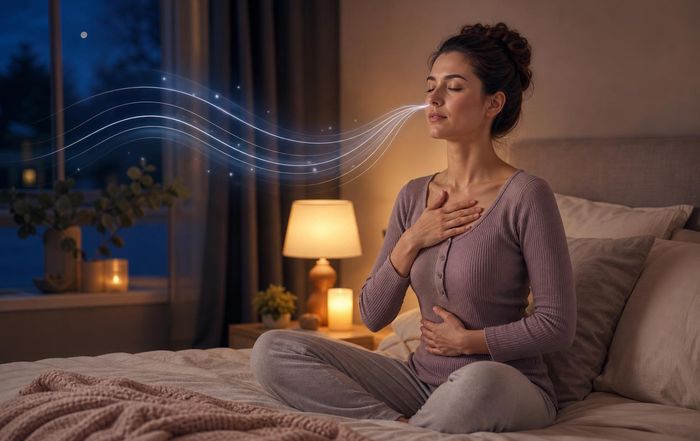
To try it at bedtime, lie on your back with your head supported and knees either bent or resting on a pillow. Place one hand on the upper chest and the other on the abdomen, just below the ribcage. Gently close the eyes if that feels safe and comfortable. Inhale slowly through the nose, aiming to let the lower hand rise as the belly expands while keeping the upper chest relatively still. Then exhale slowly through the nose or slightly parted lips, feeling the belly gently fall. The breath should be smooth and unforced; if dizziness occurs, shorten the practice and breathe more naturally.
A simple pattern is to breathe in for a count of four and out for a count of six, but this can be adjusted. The goal is not to fill the lungs to maximum capacity or to hold the breath for long periods, but to cultivate a sense of slow, rhythmic movement. Practicing for five to ten minutes while lying in bed-perhaps after completing a nighttime skincare routine-can be enough to notice a shift in tension around the shoulders, jaw, and chest. Over time, the body may begin to associate this specific breathing pattern with the approach of sleep, making it easier to unwind on nights when the mind feels busy.
Exercise 2: 4-7-8 Breathing for Gentle Sedation
The 4-7-8 technique was popularized by integrative medicine physician Dr. Andrew Weil, who adapted it from ancient pranayama breathing practices. It involves a simple ratio: inhale for four counts, hold the breath for seven counts, and exhale for eight counts. While the specific numbers are more traditional than scientifically mandated, the overall effect-a longer exhale than inhale, with a brief pause-can promote relaxation and may help some people fall asleep more quickly.
To practice, sit or lie comfortably, with the tip of the tongue resting gently behind the upper front teeth. Exhale completely through the mouth, making a soft "whoosh" sound. Close the mouth and inhale quietly through the nose for a count of four. Hold that breath for a count of seven, then exhale fully through the mouth for a count of eight, again with a gentle sound. This sequence counts as one breath cycle. Beginners are often advised to start with four cycles, once or twice a day, and gradually increase if it feels comfortable.
The extended exhale is particularly relevant for bedtime because it stimulates the vagus nerve and parasympathetic response, which can slow heart rate and foster a sense of calm. While there is limited direct clinical research on this exact pattern, it aligns with broader evidence on paced breathing and autonomic regulation in anxiety and insomnia. Anyone with cardiovascular or respiratory conditions should check with a healthcare provider before adopting breath-holding techniques, and if the seven-count hold feels uncomfortable, shortening it is entirely acceptable. The technique is meant to soothe, not strain.
Exercise 3: Box Breathing for an Overactive Mind
Box breathing-sometimes called square breathing-is widely used in high-stress environments, including by athletes and military personnel, to restore focus and reduce physiological arousal. It involves four equal phases: inhale, hold, exhale, hold. For bedtime, the counts can be softened and lengthened to create a more restful rhythm.
To begin, picture a square. Inhale through the nose for a count of four as you mentally trace the first side of the square. Hold the breath gently for a count of four as you trace the next side. Exhale slowly through the nose or mouth for a count of four along the third side, and hold again for a count of four to complete the square. Repeat this cycle for several minutes. As the body relaxes, the count can be extended to five or six if that feels natural.
This method can be particularly helpful for people who find their thoughts spiraling at night. The structure gives the mind something simple and repetitive to focus on, reducing attention to intrusive worries. Some mental health practitioners and organizations like Mind (UK) and various mindfulness-based stress reduction programs recommend box breathing as a grounding technique during anxiety spikes, which can translate well to pre-sleep use. However, anyone prone to panic or breath-related anxiety should be gentle with the holds; if holding the breath feels triggering, it is better to emphasize the inhale and exhale only.
Box breathing also pairs well with other relaxation strategies, such as progressive muscle relaxation or guided imagery. It can be integrated into a broader bedtime wellness routine that may include light stretching, journaling, or reading in soft light to gradually ease the nervous system into rest mode.
Exercise 4: Extended Exhale Breathing (The 2:1 Ratio)
One of the simplest and most sleep-friendly methods is extended exhale breathing, where the out-breath is roughly twice as long as the in-breath. This ratio is supported by research showing that longer exhalations tend to increase parasympathetic activity and reduce sympathetic arousal. For example, studies published in journals such as Psychophysiology and Journal of Physiological Anthropology have explored how exhalation-focused breathing can lower heart rate and induce calm.
To practice, settle into a comfortable lying position. Inhale through the nose for a count of three or four, then exhale gently through the nose or mouth for a count of six to eight. The counts do not need to be perfect; what matters is a noticeably longer exhale that still feels easy and unforced. If any air hunger or strain appears, shorten the counts and return to a natural rhythm before trying again.
This technique is particularly useful because it is easy to remember and adapt. It can be used when someone wakes up in the middle of the night and feels restless, or during moments of pre-sleep tension after a long day. It also pairs well with skincare and body-care rituals: for example, applying a body lotion or hand cream in time with the breath-inhale while smoothing product over the skin, exhale while massaging it in-can turn a basic beauty routine into a calming, breath-synchronized practice.
Exercise 5: Mindful Counting Breath for Racing Thoughts
When the mind is full of to-do lists, regrets, or random memories, a structured counting practice can help redirect attention without requiring any special visualization skills. Mindful counting breath is a variant of basic mindfulness meditation that focuses on the breath and uses counting as a gentle anchor.
Lying on the back or side, begin by breathing naturally through the nose. On the next exhale, silently count "one." On the following exhale, count "two," and continue up to "ten." If the mind wanders-which it almost certainly will-simply notice that and start again at one, without self-criticism. The aim is not to reach a high number but to keep returning attention to the feeling of the breath and the count.
This method is grounded in mindfulness techniques taught in programs like Mindfulness-Based Stress Reduction (MBSR), developed at the University of Massachusetts Medical School, and supported by a large body of research showing benefits for anxiety, depression, and sleep quality. For instance, randomized controlled trials published in JAMA Internal Medicine have found that mindfulness practices can improve insomnia symptoms and reduce sleep disturbances in older adults.
Mindful counting breath can be practiced for five, ten, or even twenty minutes, depending on comfort and schedule. For some, it becomes a kind of mental "cleanse" at the end of the day, helping to clear mental clutter much like a double-cleanse removes sunscreen and makeup. Integrated with other calming habits-such as reading a few pages of a non-stimulating book or listening to soft music-it can form the core of a personalized nighttime guide and tips strategy.
Integrating Breathing Into an Overall Bedtime Routine
Breathing exercises are most effective when they are part of a consistent routine rather than a last-minute fix on especially stressful nights. Sleep specialists often emphasize sleep hygiene-a set of everyday behaviors that support stable circadian rhythms and good sleep quality. Organizations like the National Sleep Foundation and NHS (UK) recommend regular sleep and wake times, a cool, dark, and quiet bedroom, limiting caffeine and heavy meals late in the day, and reducing screen exposure in the hour before bed.
Breathing can be woven into this framework in a way that fits individual lifestyles. For example, a simple sequence might look like this: finish dinner at least two to three hours before bed, dim lights and avoid stimulating content, complete a gentle skincare routine with hydrating products, then spend five to fifteen minutes on diaphragmatic breathing or extended exhale breathing while already in bed. On particularly anxious evenings, adding a short period of box breathing or 4-7-8 breathing can help bridge the gap between mental busyness and sleepiness.
For those interested in tracking the impact of these practices, wearable devices and sleep apps can provide data on heart rate, heart rate variability, and sleep stages. While not always perfectly accurate, they can offer a sense of whether a new breathing habit is associated with feeling more rested or spending less time awake after going to bed. However, experts caution against becoming obsessed with "sleep scores," as that can paradoxically increase anxiety. The subjective feeling of waking up more refreshed and less groggy is often a more important indicator than any single metric.
Safety, Limitations, and When to Seek Help
Although simple breathing exercises are generally safe for healthy adults, there are important caveats. People with chronic respiratory conditions such as asthma, COPD, or severe allergies should consult a healthcare provider before experimenting with new breathing patterns, especially those involving breath holds. Similarly, individuals with certain cardiac conditions, low blood pressure, or a history of fainting should proceed cautiously and may need personalized guidance.
Breathing exercises are also not a standalone treatment for serious sleep disorders. Conditions like obstructive sleep apnea, restless legs syndrome, or chronic insomnia typically require medical evaluation. Persistent symptoms such as loud snoring, gasping during sleep, frequent night-time awakenings, or excessive daytime sleepiness warrant a discussion with a healthcare professional or sleep specialist. Reputable resources such as the American Academy of Sleep Medicine, Sleep Foundation, and national health services provide overviews of warning signs and treatment options.
On the mental health side, some people with trauma histories or panic disorder may find certain breath practices-especially those involving breath holds or strong bodily sensations-uncomfortable or triggering. In these cases, it may be better to focus on very gentle, natural breathing with minimal counting, or to work with a therapist trained in trauma-sensitive mindfulness approaches. The goal is always to increase a sense of safety and agency, not to push through distress.
Finally, it is worth acknowledging that lifestyle stressors-demanding work schedules, caregiving responsibilities, financial pressures-can limit how much time and energy someone can devote to pre-sleep rituals. In those contexts, even two or three minutes of extended exhale breathing while lying in bed can be valuable. Consistency often matters more than duration, and small, realistic practices are more likely to stick than elaborate routines that feel impossible on busy nights.
Making Breathing Exercises Your Own
The most effective bedtime breathing practice is the one a person will actually do. Some will gravitate toward the structure of 4-7-8 or box breathing; others will prefer the simplicity of diaphragmatic or extended exhale breathing. It can be helpful to experiment for a week or two with each technique, noticing which feels most natural and which seems to make the biggest difference in how quickly sleep arrives.
Pairing breathing with existing habits can also support consistency. For beauty-focused readers, that might mean linking a breathing exercise to the moment the last layer of night cream or facial oil goes on, effectively turning each application into a cue for relaxation. For those more interested in broader health and fitness, breathing can be a cool-down extension after an evening stretch or yoga routine. Over time, the brain begins to associate these small rituals with rest, making the transition from day to night smoother and more predictable.
In a culture that often celebrates productivity and constant stimulation, taking five to ten minutes to lie still and breathe can feel almost radical. Yet it is precisely this pause-quiet, simple, and free-that can support not only better sleep but also brighter skin, steadier mood, and more sustainable energy the next day. With a few straightforward techniques and a bit of experimentation, breathing exercises can become a reliable anchor in the nightly wind-down, helping the body and mind remember how to let go.
