
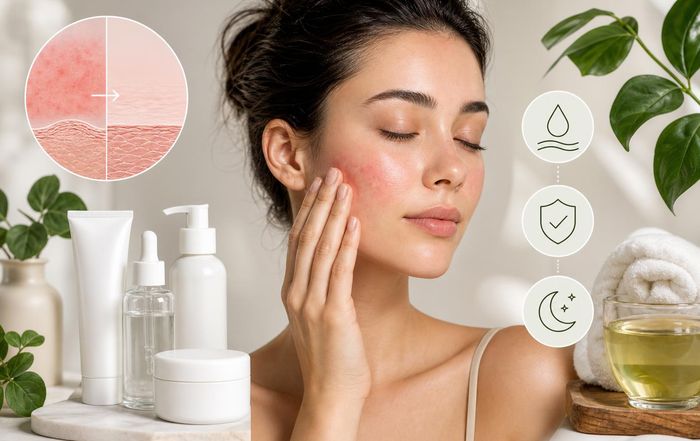
How to Recover From Over-Exfoliating Your Face (Without Making It Worse)
When exfoliation goes from glow-boosting to barrier-damaging, skin can suddenly feel hot, tight, stingy, and strangely rough and shiny at the same time. Over-exfoliation is one of the most common reasons people with otherwise "normal" routines suddenly develop redness, burning, or breakout-like irritation. The good news: most cases are reversible with time, the right products, and a gentler approach.
This document explains exactly what over-exfoliation does to your skin, how to know if that's really what happened, and step-by-step how to repair your barrier as quickly and safely as possible.
What Over-Exfoliation Actually Does to Your Skin
Healthy skin is protected by the stratum corneum, the outermost layer made up of dead skin cells, lipids (ceramides, cholesterol, fatty acids), and your natural moisturizing factors. Together, they form the skin barrier that keeps water in and irritants out. Exfoliation is meant to refine this layer, not strip it away.
Over-exfoliation can happen with:
Too-frequent use of acids (AHAs like glycolic, lactic; BHAs like salicylic; PHAs).
Combining acids with retinoids, benzoyl peroxide, or strong vitamin C.
Harsh physical scrubs or cleansing brushes used aggressively.
At-home devices or peels used incorrectly.
When you go too far, you remove too many corneocytes and disrupt the lipids that hold them together. Research shows that even a single strong exfoliation can temporarily increase transepidermal water loss (TEWL), a key marker of barrier damage, and make skin more permeable to irritants and allergens. The American Academy of Dermatology notes that overuse of exfoliants is a frequent trigger for contact dermatitis and sensitivity, especially in people using acne or anti-aging treatments.
This is why skin can suddenly react to products it used to tolerate. Your barrier is thinner, more porous, and your nerve endings are less protected, so even water or a bland moisturizer may sting.
Signs You've Over-Exfoliated (And How to Tell From a Breakout or Allergy)
Recognizing barrier damage early helps you stop the cycle before it becomes chronic sensitivity. Typical signs of over-exfoliation include:
Burning or stinging when you apply water, cleanser, or moisturizer.
Redness or flushing, especially on the cheeks, around the nose, or chin.
Tightness and dehydration, sometimes with shiny, "plastic-like" skin.
Increased sensitivity to products, heat, wind, or sun.
Fine flaking or peeling, especially around the mouth or nose.
Breakout-like bumps that are small, uniform, and more irritated than typical acne.
Visible veins or diffuse redness in people with lighter skin tones; in deeper skin tones, over-exfoliation may show more as dryness, ashy or grey tone, and heightened sensitivity rather than obvious redness.
It can be confused with:
Allergic contact dermatitis: often intensely itchy, with swelling or blisters. This is usually triggered by a specific ingredient (fragrance, preservative, dye, etc.) rather than just frequency of exfoliation. The American Contact Dermatitis Society and many dermatology clinics offer patch testing when allergies are suspected.
Purging from actives: breakouts occurring in areas where you usually get acne (cheeks, jawline, T-zone), without burning, rawness, or extreme sensitivity. Purging is more common with retinoids or BHA, but it doesn't typically make your entire face feel sunburned.
If your skin feels hot, raw, and suddenly intolerant of your normal routine after increasing exfoliation, treat it as barrier damage first. If symptoms are severe (swelling, oozing, cracked skin, or pain), seek medical care rather than self-treating.
Immediate First Aid: What To Stop, What To Keep
The fastest way to recover is to remove what's hurting your skin and simplify your routine.
Stop (At Least Temporarily)
For at least 1-2 weeks, and sometimes longer, avoid:
All exfoliants: glycolic, lactic, mandelic, salicylic acid, PHAs, enzyme peels, scrubs, microdermabrasion tools, exfoliating toners or pads.
Retinoids: including prescription tretinoin, adapalene, and over-the-counter retinol or retinaldehyde.
Strong or low-pH vitamin C (L-ascorbic acid serums).
Benzoyl peroxide and strong acne spot treatments.
Foaming or gel cleansers that leave skin feeling squeaky-clean or tight.
Fragranced or essential-oil-heavy skincare, which can sting compromised skin.
Hot water, steam facials, and saunas on the face.
If you're on prescription acne or anti-aging medication, do not stop without guidance; instead, speak to your dermatologist about a temporary reduction or adjustment. Many dermatologists, including those referenced by the American Academy of Dermatology and British Association of Dermatologists, recommend "rest periods" or buffering techniques when irritation becomes significant.
Keep (But Choose Gently)
Your temporary routine should focus on three pillars: ultra-gentle cleansing, intensive moisturization, and strict sun protection.
A simple barrier-repair routine might include:
A very gentle, fragrance-free cleanser once or twice daily.
A soothing, hydrating serum or essence (optional, but helpful if well tolerated).
A rich, barrier-supporting moisturizer morning and night.
A broad-spectrum sunscreen SPF 30+ every morning, even indoors near windows.
A minimal routine like this aligns well with building stable skincare routines and can be easier to maintain while your skin recovers.
Step-By-Step Recovery Routine (Days 1-14+)
Everyone heals at a different pace, but most over-exfoliated skin improves significantly within 2-4 weeks if treated gently. Think of this as a structured "skin rehab" plan rather than a permanent routine.
Step 1: Switch to a Barrier-Safe Cleanser
Cleansing should remove sweat and pollution without stripping lipids. Look for:
Cream, lotion, or milk cleansers labeled for "sensitive" or "barrier-repairing" skin.
pH-balanced formulas (around 4.5-5.5).
Fragrance-free and alcohol-free where possible.
Dermatologists frequently recommend gentle cleansers such as CeraVe Hydrating Cleanser, La Roche-Posay Toleriane Hydrating Gentle Cleanser, or Avene Extremely Gentle Cleanser for compromised skin; their formulations focus on minimal surfactants and barrier-friendly ingredients, as described on their official product pages and supported by brand-sponsored but peer-reviewed studies.
Use lukewarm water, avoid washcloths or cleansing brushes, and gently pat dry with a soft towel. If your skin is extremely irritated, you may cleanse only at night and rinse with water in the morning, an approach many sensitive-skin dermatology protocols support.
For more ideas on gentle cleansing within a broader beauty routine, readers can explore our skincare section.
Step 2: Layer Soothing Hydration
Hydration calms the skin and helps restore the natural moisturizing factors lost through over-exfoliation. Look for:
Humectants: glycerin, hyaluronic acid, panthenol (pro-vitamin B5), aloe vera.
Soothing agents: allantoin, bisabolol, madecassoside, colloidal oatmeal, beta-glucan.
Minimal fragrance and actives: avoid "brightening" or "anti-aging" serums for now.
Ingredients like panthenol and beta-glucan have been shown in dermatologic research to improve hydration and reduce irritation in compromised skin, including after laser treatments and peels. Brands such as La Roche-Posay, Avene, and Eucerin highlight these ingredients in products specifically marketed for post-procedure or sensitive skin, and their official clinical summaries can be found on their respective websites.
Apply a hydrating serum to slightly damp skin and allow it to absorb fully before moisturizing. If everything stings, you may need to skip serums and rely solely on a bland cream until sensitivity decreases.
Step 3: Seal With a Barrier-Repair Moisturizer
This is the core of your recovery plan. You want a moisturizer that mimics the skin's own lipid structure and helps rebuild the barrier:
Look for ceramides, cholesterol, and fatty acids in the ingredients list.
Consider products containing shea butter, squalane, or petrolatum for occlusion.
Choose thick creams or balms rather than gels or lightweight lotions.
The concept of "physiologic lipid" moisturizers-those that combine ceramides, cholesterol, and fatty acids in ratios similar to healthy skin-comes from barrier research by dermatologists such as Dr. Peter Elias, whose work is often cited in journals like the Journal of Investigative Dermatology and summarized in dermatology textbooks and clinical guidelines.
Well-known examples include barrier-repair creams from CeraVe, EpiCeram (a prescription emollient), and La Roche-Posay Cicaplast Baume B5, all of which publish ingredient lists and clinical data on their official sites. While individual responses vary, these types of products are often recommended post-procedure and after over-exfoliation.
If your skin is very raw or flaky, a thin layer of plain petrolatum ointment (like Vaseline) over your moisturizer at night-sometimes called "slugging"-can reduce water loss. However, in acne-prone or very oily skin, patch test first and avoid thick occlusion in hot, humid climates, where it may feel suffocating or clogging.
Readers interested in how barrier-repair fits with broader wellness and lifestyle routines may find it useful to consider sleep, stress, and diet as part of overall skin health.
Step 4: Protect From UV Aggressively
Sun exposure is one of the biggest obstacles to barrier recovery. Over-exfoliated skin is more vulnerable to UV-induced inflammation and pigmentation, particularly in medium to deep skin tones, where post-inflammatory hyperpigmentation can be more pronounced and longer-lasting.
Follow these principles:
Use a broad-spectrum SPF 30 or higher every morning, as recommended by the American Academy of Dermatology and organizations like Cancer Research UK.
Prefer mineral (physical) filters like zinc oxide and titanium dioxide if chemical filters sting.
Reapply every 2 hours if outdoors, and more often with sweating or swimming.
Add physical protection: wide-brimmed hats, sunglasses, and shade when possible.
Many dermatology associations, including the AAD and British Association of Dermatologists, emphasize that consistent sun protection is crucial when using exfoliating acids or retinoids precisely because the barrier is more fragile. This becomes even more important while you are actively healing.
For more on how sun care sits alongside makeup and complexion products, you can explore our makeup coverage, especially if you rely on tinted formulas or foundations with SPF.
Ingredients That Help Over-Exfoliated Skin Recover
While "less is more" is the main rule, certain ingredients can actively support healing when used in simple, well-formulated products.
Helpful ingredients include:
Ceramides, cholesterol, fatty acids: replenish barrier lipids.
Niacinamide (at low concentrations, around 2-4%): supports barrier function and reduces redness; higher strengths may sting in some people with compromised skin.
Panthenol (B5): humectant and soothing, helps with irritation.
Centella asiatica (madecassoside): anti-inflammatory, used in many "Cica" creams popular in South Korea; several studies published in journals like Clinical, Cosmetic and Investigational Dermatology suggest benefits in wound healing and barrier support.
Colloidal oatmeal: widely recognized by regulators such as the U.S. FDA as a skin protectant for eczema and irritation, with anti-inflammatory and soothing properties.
Squalane: a lightweight, non-comedogenic emollient that mimics skin's natural lipids.
Approach "barrier serums" and "repair masks" marketed on social media with caution. Many contain beneficial ingredients, but some are overloaded with fragrance, essential oils, or high percentages of actives that may be too strong for very sensitized skin. It is often safer to start with products formulated specifically for eczema-prone or post-procedure skin, which tend to follow stricter tolerability standards.
For readers interested in the science behind ingredients and how to choose between brands, our brands and products section often breaks down formulations and marketing claims.
What To Avoid While Your Skin Heals
In addition to obvious exfoliants, some everyday habits can quietly slow recovery or keep irritation simmering.
Try to avoid:
Makeup wipes and micellar waters that don't require rinsing: surfactants left on the skin can be irritating. If you use micellar water, rinse it off.
Heavy fragrance and essential oils in skincare, particularly citrus, mint, eucalyptus, tea tree, and lavender oils, which are common sensitizers according to dermatology resources like the Contact Dermatitis Institute.
Alcohol-heavy toners and astringents: these can strip lipids and increase stinging.
Frequent face touching or picking at flakes: this disrupts healing and can cause scarring or hyperpigmentation.
Harsh physical scrubs with large, jagged particles (e.g., crushed shells, fruit pits).
DIY acid or peel recipes using lemon juice, vinegar, or baking soda, which are not pH-controlled and can be highly irritating. Dermatologists and cosmetic chemists consistently warn against these in publications and on platforms like the American Academy of Dermatology and Skin Cancer Foundation websites.
If you are experimenting with trends such as "glass skin" routines, multi-acid cocktails, or at-home peeling solutions that promise professional-level results, remember that these are designed for intact, resilient skin and often assume a good understanding of skin tolerance and pH. When your barrier is damaged, even a "mild" peel can be too much.
For those following skincare trends on social media, our trends coverage often examines which viral routines are worth trying-and when to be wary.
How Long Does It Take Skin to Recover?
The outermost layer of the epidermis typically renews itself roughly every 28 days in younger adults, but this can slow with age and may be influenced by hormones, stress, and health. Over-exfoliation does not usually require full "regrowth" of the skin, but it does require rebuilding lipids and restoring normal cell turnover.
Typical timelines:
Mild over-exfoliation (slight stinging, mild redness, a bit of flaking): often improves noticeably within 3-7 days of stopping irritants and using a barrier-focused routine.
Moderate damage (burning, visible peeling, increased sensitivity to many products): may take 2-4 weeks to feel "normal" again.
Severe barrier compromise (cracks, oozing, swelling, or eczema-like patches): can take several months and often requires professional treatment and possibly prescription creams.
Persistent symptoms like chronic redness, visible blood vessels, or burning can unmask underlying conditions such as rosacea, seborrheic dermatitis, or eczema, which may have been partially controlled before. If your skin remains reactive for more than 4-6 weeks despite gentle care, it is worth consulting a board-certified dermatologist. Organizations like the American Academy of Dermatology, British Association of Dermatologists, and European Academy of Dermatology and Venereology maintain physician locators and patient resources.
When To See a Dermatologist Instead of Self-Treating
Most cases of over-exfoliation are uncomfortable but manageable at home. However, medical care is important if you notice:
Swelling around the eyes or lips.
Blistering, oozing, or crusting.
Deep cracks or fissures that bleed.
Severe pain, not just stinging.
Signs of infection such as pus, warmth, or fever.
Widespread rash extending beyond the face.
No improvement after 3-4 weeks of gentle care.
A dermatologist can:
Confirm whether you're dealing with barrier damage, allergy, infection, or another condition.
Prescribe topical corticosteroids, calcineurin inhibitors, or medicated barrier creams if needed.
Adjust prescription retinoids or acne therapy.
Guide you on when and how to safely reintroduce exfoliants or retinoids.
Internationally, many public health systems and dermatology associations provide guidance on accessing specialist care; checking your country's national dermatology society website is often a good starting point.
How To Reintroduce Exfoliation Safely (Once You've Healed)
Eventually, many people want to return to acids or retinoids for acne, texture, or pigmentation. The key is to go far slower than you think you need to and prioritize your barrier long-term.
A cautious reintroduction plan might look like this, once your skin feels calm and comfortable for at least 2 weeks:
Start with one category of active: either a gentle exfoliant or a retinoid, not both at once.
Use it once a week at night, sandwiched between layers of moisturizer if needed ("buffering"). For example: cleanse → moisturize → wait → apply a small amount of exfoliant → moisturize again if dry.
Monitor for 1-2 weeks. If there is no stinging, persistent redness, or new sensitivity, you can increase to twice per week.
Avoid layering multiple strong actives in the same routine: for instance, skip acids on nights you use retinoids.
Stick to low or moderate strengths initially. For example, choose lactic or mandelic acid over high-percentage glycolic, or a low-strength retinol instead of jumping straight to strong prescription tretinoin without medical guidance.
Many dermatologists recommend a "low and slow" approach for chronic use, which aligns with building sustainable beauty routines rather than chasing overnight transformation. Skin health is cumulative; consistency with gentle products often yields better long-term results than aggressive, sporadic treatments.
Lifestyle Habits That Support Barrier Health
While products are central to recovery, a few lifestyle factors can support (or sabotage) healing:
Sleep and stress: Chronic stress elevates cortisol, which can impair barrier function and exacerbate inflammation, as discussed in dermatology and psychodermatology research summarized by institutions such as Harvard Medical School and the National Institutes of Health.
Diet: A balanced intake of essential fatty acids (from sources like oily fish, flaxseed, walnuts) and antioxidants (colorful fruits and vegetables) can support skin structure and reduce oxidative stress. While no single food fixes over-exfoliation, poor nutrition can slow recovery.
Hydration: Adequate fluid intake helps maintain overall skin hydration, though it is not a substitute for topical moisturizers.
Exercise: Regular moderate activity supports circulation and overall health, which can reflect in skin resilience. Readers exploring broader health topics can look into our health and fitness and food and nutrition sections for more context.
None of these replace topical care, but they create a foundation where the skin is better able to repair itself.
Putting It All Together
Recovering from over-exfoliation is less about finding a miracle product and more about removing stressors, respecting your barrier, and giving skin the time and support it needs to rebuild. A practical approach is:
Strip your routine back to a gentle cleanser, barrier-repair moisturizer, and sunscreen.
Add soothing hydration and barrier-supportive ingredients if your skin tolerates them.
Avoid exfoliants, retinoids, and strong actives until your skin feels fully calm.
Practice patience: think in weeks, not days.
Reintroduce actives slowly and strategically, prioritizing long-term skin health over quick fixes.
For those people who enjoy exploring new products and trends, it can be helpful to view exfoliation as just one tool among many in your skincare and guides and tips arsenal-not the main driver of healthy, glowing skin. A strong, resilient barrier will always be a better foundation for any beauty routine than the most intense peel.
